Posts

FPGA for dummies - free book

Image
This post is now hosted here

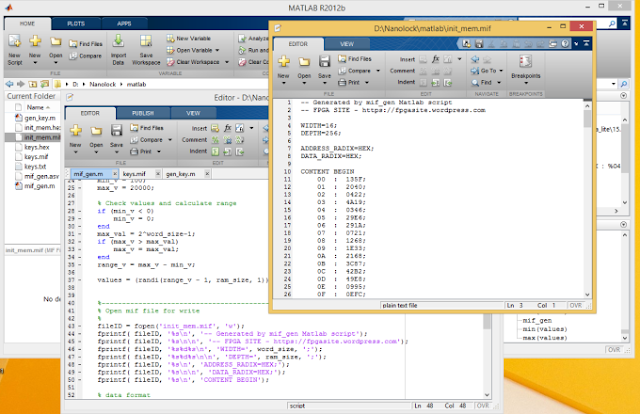
MIF_Gen - A Matlab Utility

Image
Many times I find myself in the need of generating data for testing. We need data for verification, either done on simulation or on the real target. One easy way to test our system is to generate data vectors on RAM. Altera RAM IP includes the ability to initialize RAM contents during power-up by means of a .hex file. One problem of the .hex file format is that it is quite unreadable for humans. Altera came to our rescue with the .mif format, which is text based and very easy to understand. The application I present below initializes a memory (generating an .hex file). The size and width of the memory are parameters. The Matlab application generates both a init_mem.mif and a init_mem.hex file. 1 2 3 4 5 6 7 8 9 10 11 12 13 14 15 16 17 18 19 20 21 22 23 24 25 26 27 28 29 30 31 32 33 34 35 36 37 38 39 40 41 42 43 44 45 46 47 48 49 50 51 52 %------------------------------------------- % Generate Parameters ram_size = 256 ; % In words word_size = 16...

VHDL arbiters

Image
What is an arbiter? What is an arbiter? An arbiter is a very common block used on HW designs. I think I can find the best example of an arbiter at home. When my two kids were teenagers, I had only one car. On Friday and Saturday evenings, there was usually a conflict over who got to use the car. Usually, it was on me to decide (arbiter) who got the car. Not an easy task. (I still have only one car. It just happens that my kids are not teenagers anymore, and praise the Lord, they have their own cars). Continue reading...  

FPGAs and Deep Machine Learning

Image
The concept of machine learning is not new. Attempts at systems emulating intelligent behavior, like expert systems, go as far back as the early 1980's. And the very notion of modern Artificial Intelligence has a long history. The name itself was coined at a Dartmouth College conference (1956), but the idea of an "electronic brain" was born together with the development of modern computers. AI as an idea accompanies us from the dawn of human history. Three latest development are pushing forward "Machine Learning": Powerful distributed processors Cheap and high volume storage High bandwidth interconnection to bring the data to the processors As in many other fields, development of Machine Learning is also seeing development on algorithms that take advantage of the new hardware capabilities. There are four types of algorithms used in machine learning: Supervised - The vast majority of systems today. These systems are 'trained' based on past d...

Guinness - GUI based Neural Network Synthesizer

Image
Guinness is a GUI based framework that includes both a training on a GPU, and a bitstream generation for an FPGA using the Xilinx SDSoC. This tool uses the Chainer deep learning framework to train a binarized CNN. Also, it uses optimization techniques for an FPGA implementation. Compared with the conventional FPGA realizations, although the classification accuracy is 6.5% decayed, the performance is 2.45 times faster, the power efficiency is slightly better, and the area efficiency is 2.68 times better. Compared with the ARM Cortex-A57, it is 136.8 times faster, it dissipates 3.1 times much power, and its performance per power efficiency is 44.7 times better. Also, compared with the Maxwell embedded GPU, it is 4.9 times faster, it dissipates 1.3 times much power, and its performance per power efficiency is 3.8 times better.  Details are shown in following papers: [Nakahara IPDPSW2017] H. Yonekawa and H. Nakahara, "On-Chip Memory Based Binarized Convolutional Dee...

SETI's FPGAs

Image
FPGAs and GPUs: a Tour of SETI's Computer Hardware David MacMahon is a research astronomer with Berkeley SETI Research Center. Dave works on several projects at BSRC, including Breakthrough Listen, designing many of the computer systems we use to process data collected from our telescopes. If you've ever been curious what hardware is required to search for ET, check out this tour of Berkeley SETI behind the scenes.

Slight Street Sign Modifications Can Completely Fool Machine Learning Algorithms

Image
Image Source: Linked In Machine Learning is a hot I+D topic. One of the strategies used in Machine Learning is to learn by means of neural networks. You can get a free introduction to neural networks here . I also warmly recommend Andrew Ng's introductory course to Machine Learning on Coursera . Machine Learning neural networks were inspired by biological neural networks, and are easily applied but highly effective in image processing algorithms, like handwritten text recognition. More complex neural networks algorithms are being implemented on what is called Deep Machine Learning, using neural networks with many layers of complexity. Typically a neural network is trained, or it learns, from its exposure to thousands of 'good' and 'bad' examples of the image to be recognized or classfied. For example, a neural network that has to recognize handwritten numbers, will be exposed to thousands of examples of numbers written by different people, and even with...